
What is USDT and how much is it worth in Mexican pesos?
21 Sep 2026
If you’ve ever seen “USDT” in an app, a wallet, or even a WhatsApp group and wondered what the heck it means, the basic idea is actually pretty simple. USDT is a cryptocurrency designed to maintain a value close to the US dollar.
That’s why something can seem confusing at first: one USDT aims to be worth 1 dollar, but when you see its value in Mexican pesos, the number changes. It’s not because USDT has a fixed price in pesos, but because the exchange rate between the dollar and the peso moves.
So, what is USDT in terms of money, how much is it worth in Mexican pesos, and what should you check before buying or sending it? Let’s take it step by step.
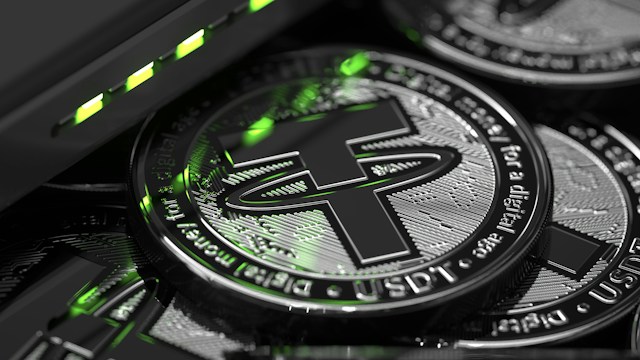
A digital dollar issued by a company
USDT is issued by Tether and it’s a cryptocurrency like many others, but with a trick up its sleeve: it tries to stay pegged to the US dollar. That’s why it’s known as a stablecoin, or stable cryptocurrency. While Bitcoin or Ethereum can go up and down like a roller coaster, USDT aims to keep 1 token worth roughly 1 dollar at all times.
But watch out for that key word: aims. It’s not a bulletproof guarantee, and it doesn’t mean the price can never move. In fact, if you take a look at USDT’s history on CoinGecko, you’ll see that between September 6 and 10, 2026, it closed at 0.999703, 0.999813, and 0.999957 dollars. Those are tiny variations, sure, but that’s exactly why we say it aims for a peg rather than having a price locked in place.
USDT is one of the largest cryptocurrencies out there. As of September 12, 2026, CoinGecko recorded a market capitalization of around $183.426 billion. In other words, it’s not some tiny or experimental coin; it has a considerable size in the market.
And you might be wondering: where does that value come from? Well, Tether explains that its reserves can be made up of cash, cash equivalents, and other assets. That’s why you shouldn’t interpret every USDT as literally representing a one-dollar bill sitting in a bank account. The simpler way to understand it is this: USDT is a digital token that aims to maintain a value close to the dollar and circulates on blockchain networks.

Why is USDT worth a different amount in pesos every day?
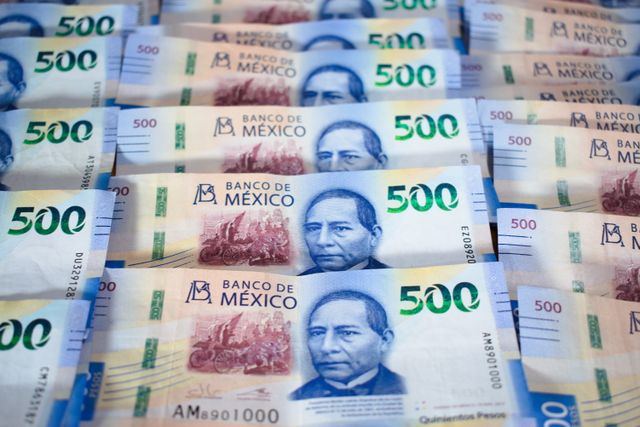
Let’s get to the part that probably brought you here after searching for “USDT to Mexican pesos.” If 1 USDT aims to be worth approximately 1 dollar, its equivalent in pesos depends on the exchange rate between the two currencies.
The simplified calculation is:
USDT in pesos = amount of USDT × USD/MXN exchange rate
For example, the latest FIX exchange rate from Banco de México available when this article was written is from September 11, 2026: 16.9707 pesos per dollar.
Using that figure, we know that 1 USDT ≈ $16.97 MXN. Keep in mind that this is a mathematical reference, not necessarily the price a platform will offer you to buy or sell USDT.
The Bank of Mexico calculates the FIX exchange rate based on wholesale foreign exchange market quotations and publishes it on banking business days. The FIX is useful as an exchange-rate reference, but it is not a specific USDT quote or a mandatory price at which a platform has to sell you the stablecoin.
That’s why, if you search for “USDT to MXN” and compare different platforms, it’s completely normal to find slightly different prices. Several factors can affect the number you see:
- The market price of USDT against the dollar
- The exchange rate
- Available liquidity
- The buying or selling price
- Any applicable fees
In other words, the Mexican peso is what makes the value of USDT change when you see it in MXN. If the dollar rises against the peso and USDT remains close to 1 dollar, the equivalent value of 1 USDT in pesos will also tend to rise. If the peso strengthens against the dollar, it will tend to fall.
The same coin on different networks
Before sending USDT, there’s one detail you absolutely can’t overlook. USDT doesn’t live on just one “highway”; it exists on several. In other words, it’s available on different blockchains such as Ethereum, Tron, Solana, and others.
Think of it like having pesos that you can send through SPEI, by transferring them to a card, or even by making a deposit at OXXO. The money is the same, but the route changes.
Here’s the golden rule: the network you use to send must be the same network the destination can receive. If you send USDT through a network that your family member’s wallet or platform doesn’t support, you could lose the money or make it very difficult to recover.
Also, fees aren’t the same on every network. Some are cheaper and faster, while others can be more expensive. Before confirming the transaction, check which network you’re using, which network the recipient expects, and how much you’ll be charged for the transfer. That way, you avoid surprises and make sure your money arrives safely.

How to choose the right network when sending or receiving USDT
When you’re about to send USDT, the most important thing isn’t the amount, but the highway you’re going to use. If the network doesn’t match between the sender and recipient, the money may not arrive or, in the worst case, could be lost. Do this first:
- Ask the recipient which network they accept. Don’t assume. Confirm whether your family member or the destination platform accepts USDT on Ethereum, Tron, Solana, or another network.
- Check that the address belongs to that network. Each network has different address formats. Make sure the destination wallet is compatible with the network you selected.
- Send a small test amount first. Before sending everything, make a test transaction with a small amount to verify that everything works correctly.
- Confirm that it arrived before sending the rest. Once the recipient confirms that they received the test amount, you can proceed with the full transfer with more peace of mind.
USDT and USDC are not the same
There are many stablecoins out there, but two of them are very, very similar, and a lot of people confuse them. They’re not the same. At first glance, USDT and USDC look almost identical. Obviously, both are stablecoins and both aim to stay close to 1 dollar. But they aren’t identical. It’s like comparing two brands of milk at the supermarket: both are milk, but they’re not the same.
To give you an idea of their differences, here are the most important ones you shouldn’t overlook:
| USDT | USDC | |
|---|---|---|
| Issuer | Tether | Circle |
| Reference | US dollar | US dollar |
| Goal | Maintain a value close to 1 USD | Maintain a value close to 1 USD |
| Reserves | Tether publishes reports about its backing, including cash and other assets | Circle publishes detailed information about reserves in cash and Treasury securities |
| Use | Widely used on exchanges and for trading | Common in payments and DeFi applications |
Neither is “better” than the other. It all depends on what you want to use it for. If you’re interested in learning how to convert stablecoins to pesos and withdraw through SPEI, you can check this guide about SPEI and crypto.
Buying USDT with pesos on B4bit
If you’re already interested in holding USDT and want to buy it with pesos, there’s a clear route you can follow. Instead of going through strange exchanges or complicated processes, you can use a platform that shows you the numbers before you confirm the transaction.
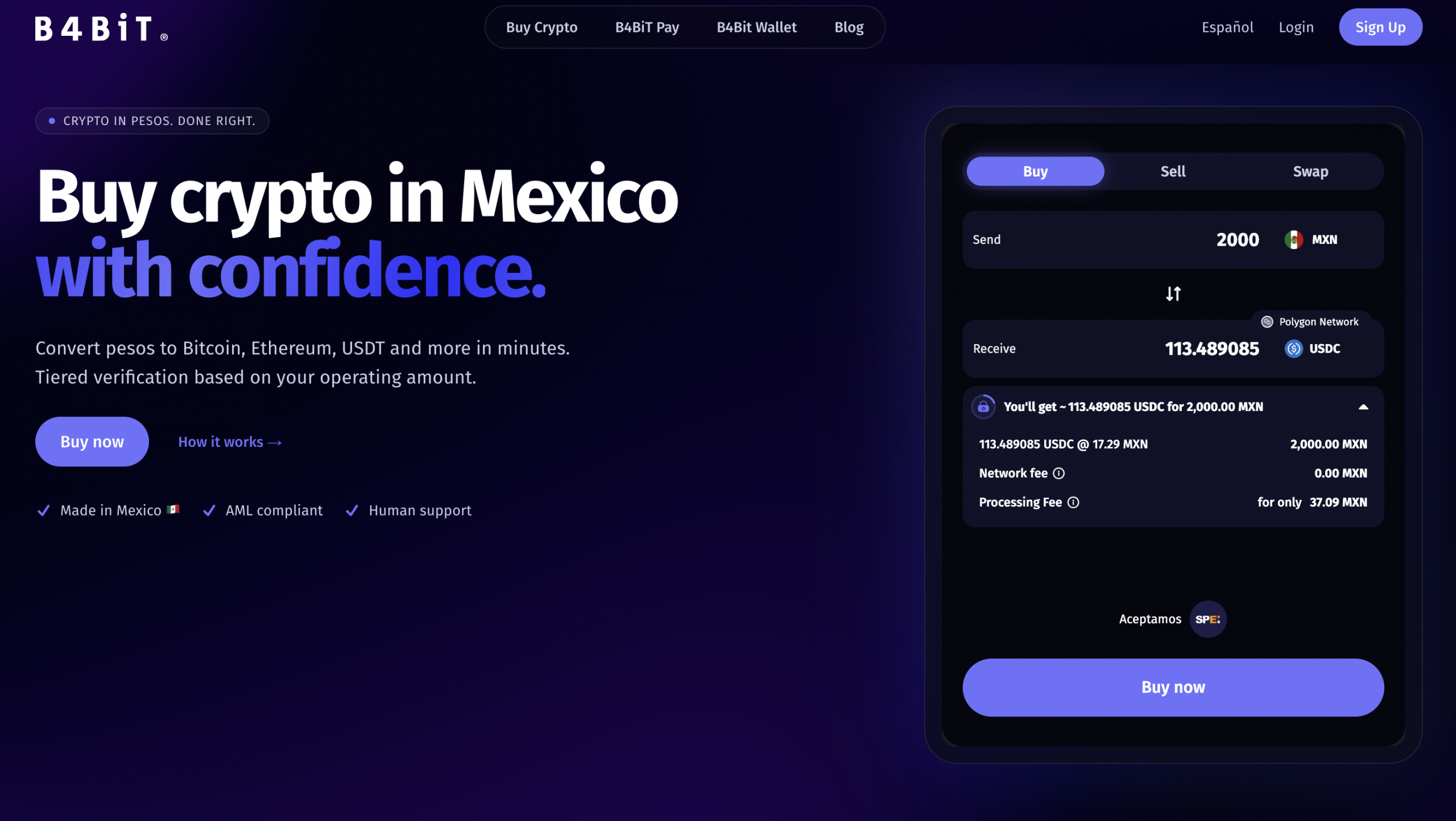
This is where B4bit comes in. The platform lets you convert pesos into cryptocurrencies such as Bitcoin, Ethereum, USDT, and more, with a clear process and visible fees. Here’s the simple version:
- Verify your identity according to the amount you’re going to trade. B4bit works with three KYC levels aligned with LFPIORPI: Basic (up to 99,999 MXN), Intermediate (100,000–249,999 MXN), and Advanced (250,000 MXN and above).
- Choose USDT and the amount in pesos. Select USDT as the cryptocurrency you want to buy and enter how many pesos you want to spend.
- Review the fees before confirming. The confirmation screen will show you the exchange rate, applicable fees, and the amount of USDT you’ll receive.
- Enter your wallet and network, then confirm. Provide your wallet address and make sure the network is correct before completing the transaction.
One important point is that you should always check the final price and fees shown on the screen before confirming any transaction. The FIX exchange rate from Banco de México serves as a reference, but it doesn’t mean that this will be exactly the price you’ll get when buying USDT on a platform.
If you’re looking for other ways to buy crypto with pesos, you can also check this guide about buying crypto with a debit or credit card.
The risks you should know about
USDT is a stablecoin, but that doesn’t mean it’s completely risk-free. You should understand the possible scenarios before using it. Here’s what you need to know before operating with USDT:
The first thing is the peg. Its goal is to maintain a value close to the dollar, but its price can temporarily move away from 1 USD. It wouldn’t be the first time the market has shown small variations in the price of this cryptocurrency.
The second issue has to do with the issuer and its reserves. When you use a stablecoin issued by a company, you depend on that company, how it manages its reserves, and the mechanisms it uses to maintain the peg.
There’s also operational risk. Tether has mechanisms to freeze certain tokens and addresses in response to requests from authorities and to comply with legal obligations.
And then there’s the simplest risk of all: making a mistake with the network or wallet address when sending your funds. Remember that USDT is not a bank deposit. Tether states expressly that its tokens are denominated in a fiat currency and backed by reserves, but Tether tokens are not fiat money. The best way to use it is to understand exactly what you’re buying, where it’s stored, and how you’re going to move it. That’s why we created this guide.
Before your next USDT transaction, compare the price you’re being offered with the day’s FIX exchange rate and pay close attention to the network you’re using. A couple of minutes spent checking everything can save you a lot of headaches later. With those two things clear, you’re already avoiding some of the most common mistakes when dealing with a stablecoin.
Frequently asked questions
1. Is USDT the same as the dollar?
No. USDT is a digital token issued by Tether that aims to maintain a value close to the US dollar. The dollar, on the other hand, is a fiat currency.
2. How much is 1 USDT worth in Mexican pesos today?
The equivalent value in pesos depends mainly on the relationship between the US dollar and the Mexican peso. As a reference, the latest FIX exchange rate from Banco de México available when this article was written was 16.9707 pesos per dollar, corresponding to September 11, 2026.
That would put 1 USDT at around $16.97 MXN if we use a 1 USDT = 1 USD parity as a reference. The final price of a transaction may be different.
3. Can I lose money with USDT?
Yes. Although USDT aims to maintain a value close to 1 dollar, its price can temporarily move away from that reference. There are also risks related to the issuer, reserves, platform operations, and mistakes when sending funds through the wrong network.
4. Which network should I use to send USDT?
There isn’t one network that is always the right choice. The correct one is the network that is compatible with both the sending and receiving sides. Before transferring, confirm which network the recipient accepts and make sure the address is compatible.
5. What is the difference between USDT and USDC?
Both are stablecoins linked to the dollar, but USDT is issued by Tether and USDC is issued by Circle. There are also differences in how each company structures and discloses information about its reserves.
What is a cryptocurrency and how its works?
Surely you’ve seen Bitcoin and cryptocurrencies popping up more and more in the news, interviews, and those conversations where someone suddenly drops…
Bitcoin or USDC? Which one suits your pocket best based on your needs
If you are here, it is because you have surely heard about the world of cryptocurrencies and are wondering which option fits…

What Is a Wallet: From Your Phone Wallet to a Crypto Wallet
The word wallet probably sounds familiar already. You’ve seen it on your phone, in a payment app, or when adding a card…