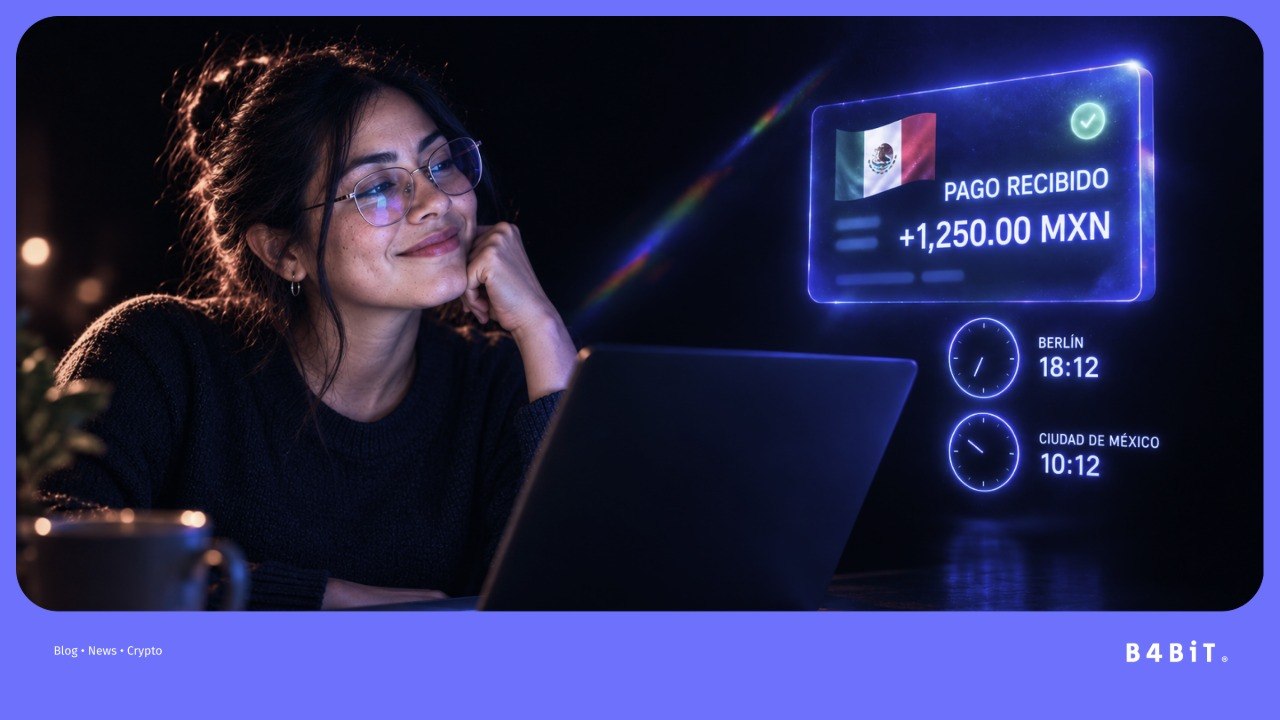
Freelancer in Mexico: How to Get Paid by Foreign Clients
21 Sep 2026
You’ve just finished the project your client asked you to work on. You send over the files and the client tells you everything looks great. Now comes the question nobody teaches you how to answer when you start working as a freelancer:
“How do I pay you?”
If your client is in the United States, Canada, or any other country, things can get a little more complicated than simply giving them your bank account details. Between the dollars your client pays and the pesos that finally reach you, there may be fees, an exchange rate you weren’t expecting, and several days of waiting.And here’s the thing: it’s not always easy to see how much it really cost you to get paid.
You can receive the same $500 USD you agreed on and end up with different amounts in pesos depending on how you receive the money and how the conversion is handled. That’s why, before sending your payment details to your client, it’s worth knowing which option you’re using, how much it could cost you, and what you need to take care of from a tax perspective.
We’re not going to make silly promises like “you’ll get paid with no fees,” but you can invoice knowing which option makes more sense for you and how to avoid getting into trouble.
First, the tax side: RFC and invoicing your foreign client
Before thinking about how the money is going to reach you, you need to look at the SAT. Just because your client is in another country doesn’t magically mean the payment is outside Mexico. If you work as a freelancer from Mexico and receive income for your services, you need to review your tax obligations in Mexico.
This is where the well-known foreign generic RFC comes in, which you’ll probably come across when preparing your invoice. When invoicing a client who lives outside Mexico and doesn’t have a Mexican RFC, use the generic foreign RFC: XEXX010101000.
That said, knowing which RFC to use is one thing, and having everything else on the invoice set up correctly is another. If you regularly work as a freelancer, it’s worth reviewing your situation with an accountant, especially if you’re just starting to work with foreign clients and aren’t sure which tax regime applies to you.

Steps for invoicing a foreign client
Let’s look at the steps you need to follow to invoice correctly:
- Register with the RFC under professional or business services.
If you work for yourself, your tax regime will depend on your situation and the type of activity you carry out. The SAT includes, among others, the Simplified Trust Regime (RESICO), but that doesn’t automatically mean it applies to every freelancer. Check the requirements directly in the SAT information about RESICO.
- Issue your CFDI.
When the client is a foreign resident who is not registered with the Mexican RFC, the SAT establishes the use of the generic RFC XEXX010101000.
- Include the client’s country and, when applicable, their tax identification number.
Don’t just copy and paste information without checking it. Review the country of tax residence, name or company name, and, when applicable, the tax identification number your client has in their country.
The SAT has specific information requirements for transactions with foreign residents, so if your client is in the United States or Canada, check which information you need to request before issuing the CFDI.
- Keep the invoice together with proof of payment.
It may seem like a small thing until, months later, you need to figure out which payment corresponded to which invoice.
If you’re paid in dollars, also keep a record of the exchange rate used for tax purposes. And if you’re not sure how that exchange rate applies to your specific situation, this is where it’s worth asking an accountant.
Three ways to receive the payment and what each one charges you
Now we get to the part you’re probably most interested in. Your client has already agreed to the price. Let’s say you agreed on $500. The question is no longer how much you’re going to charge. The question is: how many pesos will actually be left when the money arrives?
There are several ways to receive an international payment, and each one has its own costs and processing times.
International bank transfer
This is the most traditional option. Your client sends the dollars and the money eventually reaches your account. The catch is that there may be several charges along the way:
- Fee for sending the money
- An intermediary bank
- Receiving fee
- Conversion from dollars to pesos
An international transfer can also take several business days.
Before giving your client your bank details, ask your bank how much it charges to receive an international transfer and what exchange rate it uses when converting dollars into pesos. Don’t settle for just hearing “we receive international transfers.” That doesn’t tell you how much you’ll actually end up receiving.
Online payment platforms
These platforms can be very convenient for the client because the payment process is usually simpler. They simply send the dollars directly to your bank account in Mexico. That said, there may be a sending fee, an intermediary bank fee, a receiving fee from your bank, and currency conversion costs. The money may also take several business days to arrive.
Ideally, ask your bank about its exact fees before giving your client your payment details.
Digital dollars (USDC or USDT)
Another possibility is for your client to send you a stablecoin such as USDC or USDT. It can arrive within minutes, without an intermediary bank. A stablecoin is a cryptocurrency designed to maintain a value close to the dollar.
The process can be much faster, but there are other details you need to check, such as the network, the address, the transaction fee, and how you’re going to convert those digital dollars into pesos afterward.
If you want to better understand what USDC is and how it relates to the Mexican peso, you can read our guide on what USDC is and how to use it to move your pesos.
The cost almost nobody checks: the exchange rate
This is where the most money can be lost without realizing it. Getting paid $500 at an exchange rate of 16.50 is not the same as getting paid at 17.15. The difference is almost 325 pesos.
Banxico FIX exchange rate is the official reference. The central bank publishes it every business day. The formula to calculate it is very simple:
pesos received ÷ dollars charged = the exchange rate you actually received. Compare it with the FIX rate for that day.
Let’s look at an example using real data:
On September 14, 2026, the Banxico FIX rate was 17.1277 pesos per dollar. If your client pays you $500 and you receive 8,400 pesos, your actual exchange rate was 16.80 (8,400 ÷ 500). That means you lost around 163 pesos compared with the day’s FIX rate.

Getting paid in USDC and converting it to pesos with B4bit
This is where another option comes in: getting paid in USDC and converting it into pesos. When you buy crypto with pesos through B4bit, you receive it in the wallet of your choice. The same works in reverse. You can receive USDC and convert it into pesos.
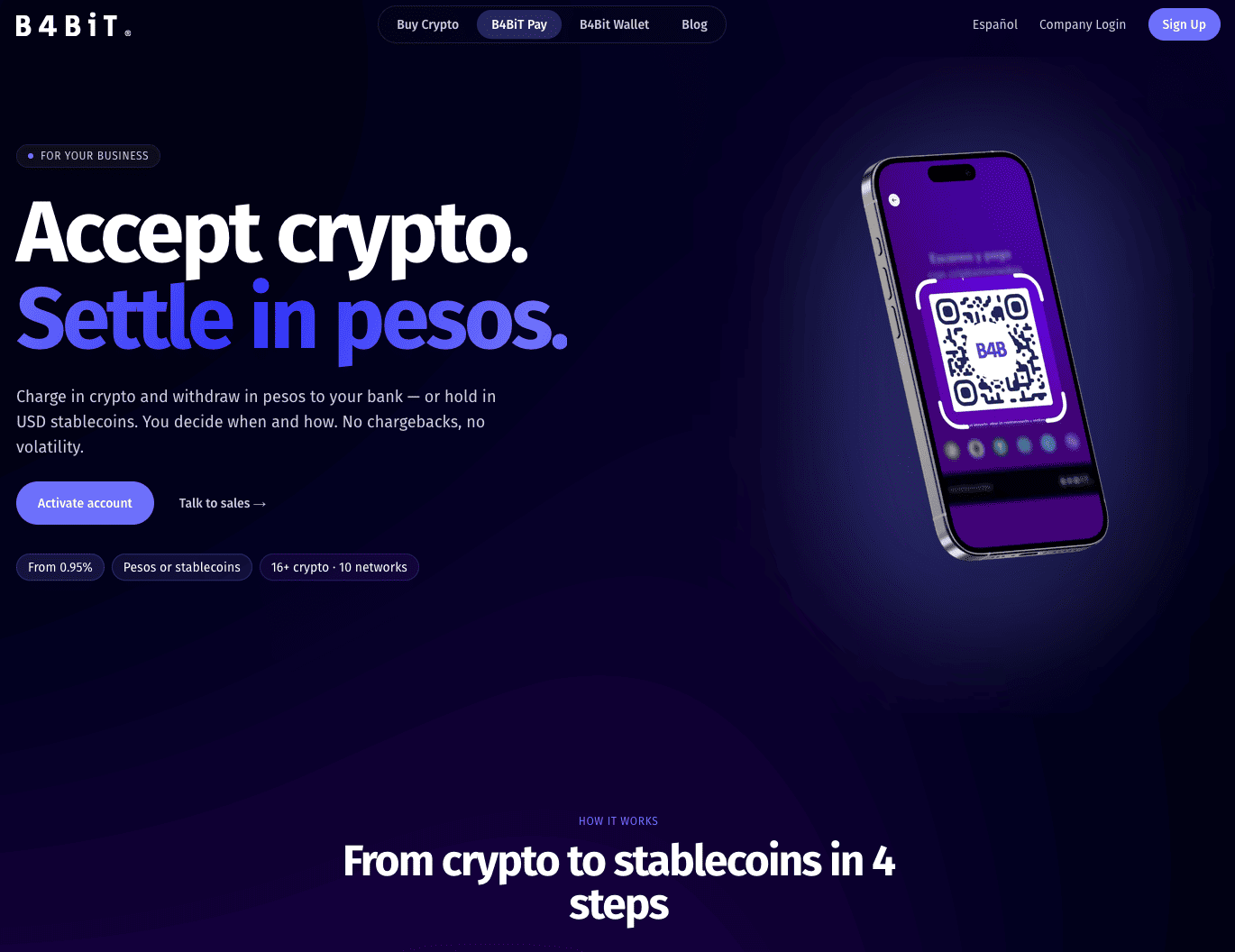
B4bit supports more than 16 cryptocurrencies across 10 networks. All fees are shown on screen before you confirm. In the B4bit Pay section, you’ll find a business product that accepts crypto payments and settles them in USD-denominated stablecoins with a fee starting at 0.95%.
The process for using B4bit as part of your payment workflow is:
- First, create your B4bit account. Register and complete the verification process required for your account and the amount you’ll be handling.
- Share your payment details. Tell your client which asset they should send you (for example, USDC) and the corresponding receiving address. It’s important that both of you are clear about which network you’ll use.
- Receive the payment. Your client sends the USDC or USDT to the address you provided. Once the transaction is confirmed on the blockchain, you’ll be able to see the balance received.
- Convert the balance into pesos. When you want to access the money in pesos, make the available conversion in B4bit and check the exchange rate and fees shown before confirming.
- Receive the pesos in your account. Once the process available for your account is completed, you’ll be able to access the pesos through the withdrawal options enabled for you.
That’s how simple it is: your client pays you in digital dollars, you receive them, and then you convert them into pesos.
What to ask your client so the payment arrives in full
To avoid the typical exchange of 15 emails asking “did it arrive?”, “what was the address?” and “how much did I send you?”, make the conditions clear from the beginning. Before getting paid, do this:
- Agree on the currency and who pays the sending fees.
Don’t assume the client knows there are fees. Ask whether they can cover the sending fees so that you receive the full amount. - For crypto, agree on the exact network.
The first time, make a test with a small amount. A network mistake can mean losing the funds. - Ask them to include a reference or invoice number with the payment.
This makes it easier to identify the payment when it arrives. - Set a clear payment date.
Don’t leave everything open-ended. A specific date helps prevent payment delays.
If it’s the first time you’re working this way, you can start with a small test amount. You don’t need to turn getting paid into a separate project. The idea is that when your client asks “How do I pay you?”, you already have the answer ready.

What can go wrong and how to avoid it
Most problems can be avoided by checking the information before accepting the payment and taking a few precautions:
- Payment rejected or held because of incomplete information. Check that all your account or wallet details are correct before giving them to the client.
- Wrong address or network when using crypto. If you send through the wrong network, you can lose the funds. Always verify the network and address before confirming.
- Stablecoins can temporarily lose their peg. In March 2023, USDC temporarily lost its peg to the dollar. It’s a risk that exists, even if it is temporary.
- Not invoicing income. If you don’t issue an invoice, you can run into problems with the SAT. Always invoice, even if the payment is in dollars or crypto.
Get paid in the way that makes sense for you
If you receive $100 or $200 several times a month, a fixed fee can have a significant impact on each payment. If you occasionally receive $2,000 or $3,000 projects, you’ll probably want to pay more attention to the exchange rate and how much you end up receiving after conversion.
So the next time your client asks “How do I pay you?”, don’t just look at the amount on the invoice. Do the full calculation. Ask yourself: How much does the client pay? How much does it cost to receive it? What exchange rate are you getting? How many pesos actually arrive?
However, that’s the amount that really matters.

Frequently asked questions
- Do I need an RFC to get paid by a foreign client? Yes, it is income in Mexico and you must declare it. Register with the RFC under professional or business services. You can find more information on the SAT website.
- What RFC should I put on the invoice for a foreign client? The generic foreign RFC is XEXX010101000. It is used when the recipient lives abroad and is not registered with the Mexican RFC.
- If I’m paid in USDC, do I have to declare it? Yes. The way you receive the money does not eliminate your tax obligations. If you receive payments this way, it is recommended that you consult an accountant about how to record and report the transaction according to your tax regime.
- How long does each type of payment take to arrive? An international transfer can take several business days. Payment platforms vary. SPEI operates 24/7 according to Banxico.
- Can I receive the money in my usual debit account? Yes. Once the funds are converted into pesos, they can be sent to a bank account through the withdrawal options available for the service you’re using. If you use B4bit, check the withdrawal options available for your account before confirming the transaction.
How to Buy Crypto with Debit or Credit Card: Bitcoin, USDC and More
If you already know how to shop online with your card, you already have almost everything you need to get started with…

What is Blockchain? The explanation nobody gave you in school
If you send money, receive a transfer, or have ever had to trust “the system” to make sure something arrives properly, this…
SPEI and Crypto: The Guide to Move Your Pesos to USDC Without Complications
Moving your money shouldn’t be a headache. If you use SPEI to pay rent, send money to your family, or settle with…